
Introduction
High-flow oxygen therapy delivered directly through a tracheostomy bypasses upper-airway structures that contribute to humidification, dead-space washout, resistance, and pressure generation; its physiology therefore differs from nasal high-flow therapy.1–4
Tracheostomized patients may require support during prolonged ventilation, weaning, decannulation, postoperative airway care, chronic respiratory failure, and secretion management. HFTO has been used to provide heated humidification and stable oxygen delivery, reduce secretion burden, support ventilator liberation, and facilitate decannulation.5–8
The evidence is fragmented. Several adult studies reported improved oxygenation with HFTO.2,9 Other studies found no change in oxygenation or arterial blood gases.3,4,10 Effects on work of breathing, neuroventilatory drive, carbon dioxide clearance, airway pressure, and lung volume were likewise inconsistent.2–4,9,10 Clinical evidence spans weaning and decannulation,6,7,11 while respiratory-therapy studies address humidification, secretion management, speaking valves, and aerosol delivery.5,8,12,13 Safety may depend on cuff status, expiratory resistance, and interface configuration.6,14–16
An independent prior scoping review by Neiva et al. included four adult HFTO studies focused on ventilator weaning and available through April 2021.17 It did not aim to compare adult and pediatric evidence. The present review extends the scope to physiology, decannulation, humidification/secretion management, device/interface studies, aerosol delivery, safety/tolerance, ongoing trials, and pediatric evidence gaps.
For respiratory therapists, bedside implementation depends on the complete configuration: device, tube size, cuff status, interface, FiO2, temperature/humidification, speaking valve, expiratory pathway, secretion burden, aerosol setup, and escalation criteria.5,6,8,12,14–16
Children differ from adults in airway and tracheostomy dimensions, leak, secretion burden, ventilatory reserve, developmental tolerance, chronic technology dependence, caregiver involvement, and decannulation pathways. Adult evidence was therefore included as a comparator to identify domains studied in adults but untested in pediatric care, not as directly generalizable evidence.
This review mapped adult and pediatric HFTO evidence, summarized flow and interface characteristics (including cuff and speaking-valve status when available), synthesized physiologic and clinical applications, humidification/secretion outcomes, safety, tolerance, and monitoring, and compared adult with pediatric evidence to define research priorities.
Methods
Design
This scoping review was conducted using established scoping review methodology and reported according to the Preferred Reporting Items for Systematic Reviews and Meta-Analyses extension for Scoping Reviews (PRISMA-ScR).18,19 The protocol was registered on the Open Science Framework on June 30, 2026, after the final database search and before formal screening, data charting, and synthesis; the registration DOI is provided on the title page to preserve blinding.
Eligibility criteria
We included adult and pediatric sources describing high-flow oxygen, heated humidified high-flow therapy, or high-flow tracheal oxygen delivered through a tracheostomy tube or related interface. Eligible sources included clinical/physiologic, implementation, bench/simulation, technical, and review reports. Case-based clinical evidence required at least two patients. Conference abstracts required an extractable population, HFTO exposure, and at least one outcome and were treated as emerging evidence. Trial records/protocols were retained only to map active research activity, not as completed evidence or support for effectiveness or safety conclusions. We excluded nasal high-flow only, conventional low-flow tracheostomy oxygen, intraoperative/apneic oxygenation without HFTO relevance, animal-only work without clinical/device-relevant contribution, and sources with insufficient HFTO-specific information. Two eligibility decisions required explicit judgment. Technical reports using a tracheostomy-compatible connector or exchange-catheter interface were retained because they inform expiratory-pathway and pressure considerations. One animal study without spontaneous ventilation was retained because it demonstrates a monitoring-relevant mechanism, preserved oxygenation with severe carbon dioxide retention; all other animal-only evidence was excluded.
Information sources and search strategy
MEDLINE/PubMed, Embase, Scopus, Web of Science, and CINAHL were searched from inception through June 30, 2026 using tracheostomy and high-flow oxygen concepts. The PubMed strategy was: (“Tracheostomy”[Mesh] OR tracheostom* OR “tracheostomy tube” OR “tracheal cannula” OR “trach tube”) AND (“high-flow oxygen” OR “high flow oxygen” OR “high-flow tracheal oxygen” OR HFTO OR HFT OR HFOT OR “heated humidified high flow” OR “high-flow therapy” OR Optiflow OR Airvo). No age restriction and no database-level language filter were applied. All 487 records were retrieved from these five databases, and all 35 included sources arose from those June 30 exports; no included source was added from outside the database set after the search. The three ongoing trial/protocol records were identified within the same database exports. A separate systematic clinical-trial-registry search was not prespecified in the original search strategy and was not added post hoc after screening; registry/protocol records encountered in the database exports were retained only to map the research pipeline. Supplementary File 1 provides the search log and reconstructed database-specific executable strategies.
Study selection
Database records were exported, merged, deduplicated, and managed in a custom Microsoft Excel screening workbook. One reviewer performed the initial title/abstract screening and full-text eligibility assessment. A second reviewer then rechecked every record-level decision at both stages against the eligibility criteria. This was complete sequential verification rather than independent parallel duplicate screening. Disagreements were resolved by discussion, with senior adjudication available. During revision, the archived workbook was re-audited against the final included-source set to verify PRISMA full-text exclusion categories and counts.
Data extraction
Data were charted with an author-developed, nonvalidated standardized form. No separate formal pilot of the charting form was documented in the archived methods materials. Variables included source design, population/model, setting, indication, device/interface, tube and cuff status when reported, speaking-valve configuration, flow, FiO2, temperature/humidification, comparator, physiologic and clinical outcomes, secretions, safety/adverse events, tolerance/monitoring, weaning/decannulation, and pediatric relevance. One reviewer performed the initial charting, after which a second reviewer rechecked every extracted field against the source and confirmed or corrected the entry. This was complete sequential verification rather than independent duplicate extraction.
Synthesis
No meta-analysis or formal risk-of-bias assessment was planned because the purpose was evidence mapping. Domains were defined from the prespecified objective and charting framework: source characteristics; flow/cuff/interface and physiology; clinical applications and care settings; decannulation; humidification/secretion management; device/interface and aerosol delivery; safety/tolerance/monitoring; and adult-pediatric gaps. The three ongoing trials/protocols were summarized separately solely to map the active research pipeline and were not used to infer effectiveness or safety.
Ethics
Ethics approval was not required because this review used publicly available published literature and did not involve human participants, patient-level data collection, or identifiable private information.
Results
Study selection
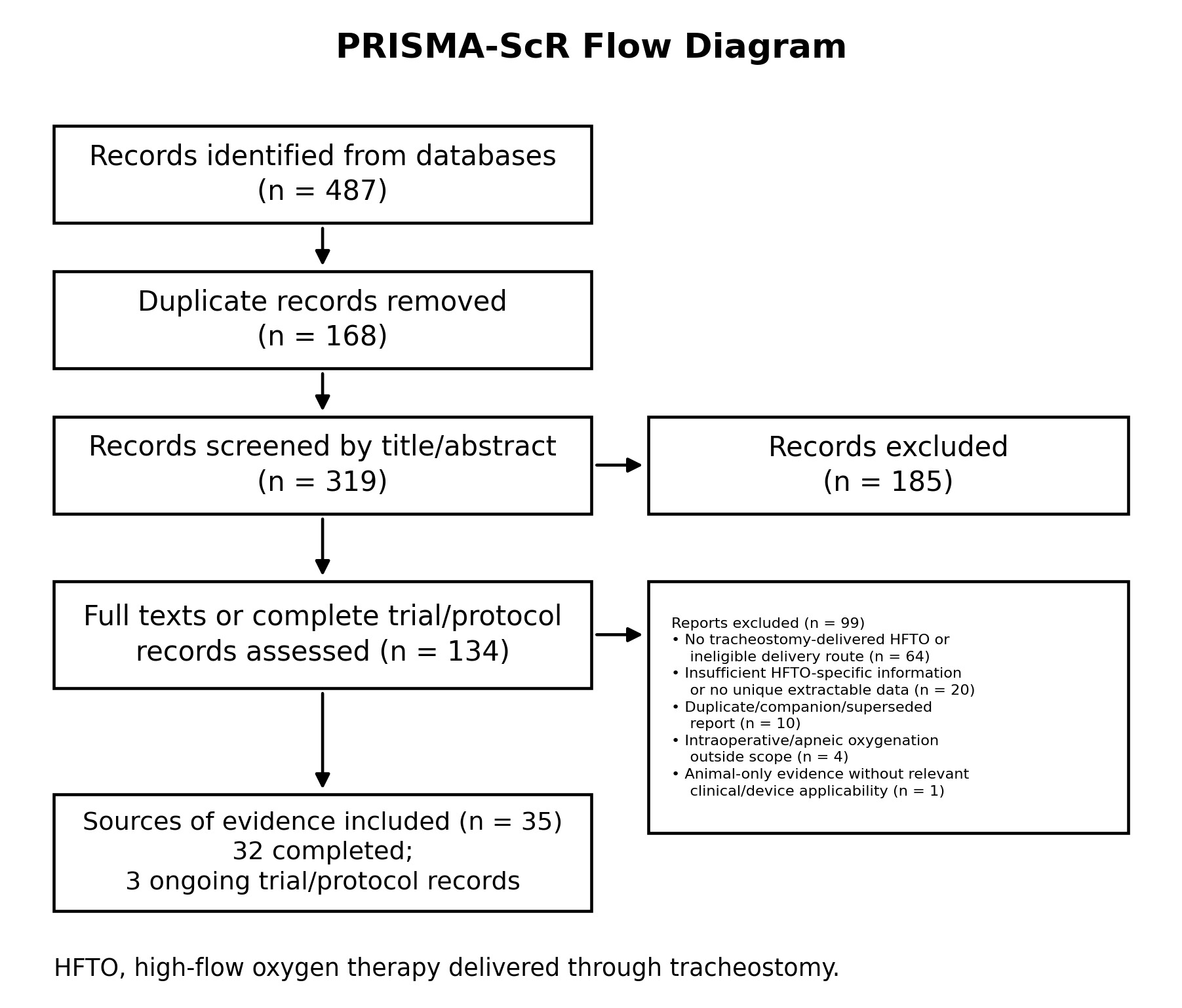
Searches identified 487 records; 168 duplicates were removed, leaving 319 records for title/abstract screening. Of these, 185 were excluded and 134 full texts or complete trial/protocol records were assessed. Ninety-nine were excluded: no tracheostomy-delivered HFTO or ineligible delivery route (n=64), insufficient HFTO-specific information or no unique extractable data (n=20), duplicate/companion/superseded report (n=10), intraoperative/apneic oxygenation outside scope (n=4), and animal-only evidence without relevant clinical/device applicability (n=1). Thirty-five sources remained: 32 completed sources and 3 ongoing trial/protocol records (Figure 1).
Study characteristics
The evidence was heterogeneous and predominantly adult. Completed sources included physiologic studies, observational cohorts, implementation studies, small case series, bench/simulation work, technical reports, one conference abstract, and reviews across intensive care, prolonged ventilation, weaning, lung-transplant recovery, postoperative care, and rehabilitation. One source directly modeled pediatric HFTO: a 2026 infant/toddler aerosol-delivery simulation.13 The three ongoing sources addressed weaning, mucus properties/respiratory effort, and external diaphragm pacing with HFTO.20–22 Source-level characteristics are provided in Supplementary Table S1.
Flow settings, cuff status, and physiologic effects
Reported adult flow settings varied widely. Physiologic and bench studies tested approximately 10-80 L/min, with 40-60 L/min most common.2,9,10,15,16,23–25 Musso et al. specifically evaluated 70 and 80 L/min in adults after liberation from invasive ventilation.10 A systematic review of five physiologic studies identified oxygenation as the most consistent signal across the available adult literature.26 Individual studies reporting improved oxygenation included Natalini et al., Corley et al., and Lytra et al.2,9,27 In contrast, Stripoli et al., Lersritwimanmaen et al., and Musso et al. found no improvement or no additional change in arterial blood gases or oxygenation.3,4,10 Effects on work of breathing, diaphragm effort, carbon dioxide clearance, end-expiratory lung volume, and clinically meaningful positive end-expiratory pressure were variable.2–4,9,10,23,26,27 Cuff status was often incompletely reported and could not be isolated as an independent effect. In a size 8 uncuffed bench model, standard HFTO generated only about 0.3, 0.5, and 0.9 cm H2O of PEEP at 40, 50, and 60 L/min, respectively.16 In contrast, a size 8 cuffed simulation using a novel higher-resistance interface generated greater PEEP and functional residual capacity across 10-80 L/min.15 Because cuff status and interface resistance differed simultaneously, these studies demonstrate the importance of expiratory leak and circuit configuration but do not establish a cuffed-versus-uncuffed treatment effect.
Clinical applications and care settings
Ventilator weaning was the most common clinical application. In a 77-patient retrospective cohort, 57 patients (74%) were liberated by 60 days, but early versus rescue HFTO did not change liberation or ventilator-free days.11 Small case series described HFTO as a bridge after difficult weaning,24,28–30 while an abstract-only controlled study reported similar dyspnea but higher RAND-36 quality-of-life scores; nonrandomized allocation and limited reporting constrain inference.31 Other reported settings included lung-transplant recovery, postoperative head and neck free-flap care, COVID-era tracheostomy care, and inpatient rehabilitation/weaning.5,31–33
Decannulation pathways
HFTO was incorporated into adult tracheostomy-liberation pathways. A multicenter randomized trial of 330 conscious adults after ventilator weaning tested an HFTO-containing decannulation strategy in which patients received continuous high-flow oxygen and suctioning frequency was used as the readiness criterion. The strategy reduced median time to decannulation from 13 to 6 days without increasing failure; the effect should therefore be attributed to the combined pathway rather than to HFTO in isolation.7 In lung-transplant recipients, tube removal occurred in 13/14 HFTO patients versus 6/13 controls in a small nonrandomized study.32 A registry combining HFTO with an in-line one-way speaking valve demonstrated feasibility during weaning.6
Humidification and secretion management
Heated humidification and secretion management may be among the most clinically important practical roles of HFTO. In 82 adults after head and neck free-flap surgery, implementation of an AIRVO-based system was associated with a reduction in excessive secretions from 40% to 11.9% and in supplemental oxygen above baseline from 25% to 7.1%; no respiratory rapid responses or ICU escalations occurred in either group.5 The study did not report flap viability, wound-healing, or flap-complication outcomes as prespecified outcomes, so the available evidence cannot determine whether heated humidification affects free-flap healing. Bench testing also showed that heat-moisture exchangers used with supplemental oxygen could provide less than 30 mg/L absolute humidity, whereas actively heated systems exceeded 30 mg/L across tested conditions.8 Aerosol-delivery models further demonstrate that nebulizer type, placement, interface, humidification configuration, and flow alter delivered dose.12,13 In the pediatric infant/toddler model, flows of 5-30 L/min were tested and aerosol dose decreased as flow increased.13
Device and interface studies
Interface configuration modifies physiologic effect and safety. Added expiratory resistance or novel interfaces increased airway pressure/lung volume in bench or preclinical models,14,15,25 whereas standard open configurations generated little pressure.16 HFTO with an in-line one-way speaking valve was tolerated clinically, but obstructed exhalation produced dangerous pressures in bench testing.6 Delivery route itself also matters: in a manikin and lung-simulator comparison of seven high-flow devices, measured work of breathing was statistically lower with tracheal than with nasal delivery, but the differences were small and of uncertain clinical importance.34 A pandemic-era technical report described practical setup of HFTO in tracheostomized adults and contributed implementation rather than comparative outcome data.33 Technical reports of alternative interfaces remain hypothesis-generating rather than definitive safety evidence.35,36
Safety, tolerance, and monitoring
Across completed clinical studies, HFTO was usually described as feasible or well tolerated, but adverse-event ascertainment was inconsistent and often not a primary outcome. Egbers et al. reported no practice-related adverse events with the tested HFTO-speaking-valve configuration, while bench testing identified high-pressure risk when exhalation was obstructed.6 Musso et al. reported no adverse events or respiratory distress during very-high-flow testing.10 Several small clinical series reported no major adverse events,24,28–30 and the free-flap implementation study reported no respiratory rapid responses or ICU escalation.5 These observations indicate no major safety signal within those small samples but do not establish safety because adverse-event definitions and ascertainment were not standardized. Mechanistic concerns include inadequate humidification with secretion thickening or mucus plugging,8 tube/interface disconnection or displacement,12 excessive pressure when expiratory pathways are restricted,6,14,15,36 and failure to recognize inadequate ventilation when oxygenation is preserved; an animal model without spontaneous ventilation, retained for its monitoring-relevant mechanism, demonstrated severe hypercapnic acidosis despite sustained oxygenation during direct tracheal oxygen delivery.37
Monitoring reflected treatment purpose. Physiologic studies followed oxygenation, respiratory rate, blood gases/carbon dioxide, respiratory effort, and hemodynamics.2–4,9,10,23 Decannulation studies incorporated suctioning frequency, airway tolerance, and failure criteria.6,7 During aerosol delivery, temporary flow reduction should be accompanied by oxygenation monitoring and prompt return to prescribed support.13 Comfort, secretion quality, mucus plugging, tube stability, cuff/valve status, escalation to ventilation, and standardized adverse-event definitions were inconsistently reported.
Adult-pediatric evidence comparison
Adult evidence covered multiple physiologic, clinical, and implementation domains summarized in Table 1. Direct pediatric evidence was limited to one infant/toddler aerosol simulation showing flow-dependent reduction in delivered dose without clinical effectiveness or safety outcomes.13 No pediatric clinical study evaluated oxygenation, work of breathing, cuff/interface physiology, secretion outcomes, tolerance, speaking-valve use, weaning, decannulation, home use, or adverse events. The pediatric evidence map is presented in Table 2, and the adult-pediatric comparison with priority gaps is summarized in Table 3.
Discussion
Interpretation of findings
The evidence suggests that HFTO should be defined by purpose and configuration rather than treated as a single intervention. Oxygenation improved in some adult studies but not others, while pressure and mechanical assistance depended strongly on interface and expiratory pathway.2–4,9,10,14–16,27 Clinically tangible benefits in some studies relate to humidification, secretion management, HFTO-containing decannulation pathways, or remaining off the ventilator rather than a large PEEP-like effect.5–8,11
Cuff status, interface, and physiologic mechanism
Cuff status deserves explicit consideration because it changes the potential expiratory leak around the tracheostomy tube and therefore interacts with interface resistance and pressure generation. The available literature does not permit a controlled cuffed-versus-uncuffed comparison: cuff status is frequently unreported, and studies that do report it use different interfaces and models.15,16 Accordingly, pressure data should not be extrapolated from one configuration to another. A cuffed tube with a restrictive or obstructed expiratory pathway may increase pressure and risk, whereas an uncuffed or cuff-deflated configuration may dissipate pressure through leak. The clinically relevant unit of reporting should therefore be the complete configuration—tube size, cuff status, interface, flow, speaking valve, and expiratory route—rather than flow alone.
Clinical and respiratory therapy implications
HFTO protocols should define the treatment goal and complete configuration. Monitoring should be indication-specific: oxygenation, respiratory effort, gas exchange when indicated, and escalation criteria for oxygenation/weaning; temperature/humidification, secretions, suction burden, patency, and plugging for secretion-focused use; and airway patency, suction burden, tolerance, and failure criteria for decannulation pathways (Table 1).
Speaking valves, comfort, and care setting
HFTO can be incorporated into a carefully configured one-way-valve pathway, but this should not be generalized without confirming an unobstructed expiratory route.6 Patient-centered evidence remains limited: one abstract reported higher quality-of-life scores but no dyspnea difference and used nonrandomized allocation.31 No direct comparison of comfort versus cold-nebulized tracheostomy humidification was identified.
Routine home/community HFTO is also not established; most studies were hospital-, ICU-, rehabilitation-, or postoperative-based. Future home studies should address caregiver training, equipment reliability, humidifier-water management, secretion surveillance, backup power, emergency plans, and escalation criteria.
Pediatric translation
Adult findings should be treated as hypothesis-generating for children, not as evidence of pediatric effectiveness or safety. The sole direct pediatric source was a 5-kg infant and 15-kg toddler aerosol simulation showing flow-dependent delivery changes across 5-30 L/min.13 No pediatric clinical data address oxygenation, work of breathing, humidification/secretion outcomes, speaking-valve use, weaning, decannulation, home use, tolerance, or adverse events. Pediatric priorities are summarized in Tables 2 and 3.
Research priorities
Future studies should use a standardized minimum dataset covering device/interface, tube and cuff/valve status, expiratory route, flow and FiO2, humidification, indication, oxygenation/ventilation, work of breathing, secretions/suction, comfort, adverse events, escalation, and weaning/decannulation outcomes. Pediatric studies should also report age, weight, diagnosis, chronic ventilator dependence, caregiver workflow, and home feasibility (Tables 2 and 3).
Strengths and limitations
A strength of this scoping review is its broad mapping of physiology, clinical application, respiratory-therapy implementation, safety, and pediatric gaps rather than ventilator weaning alone, with source-level charting for all included records. Limitations remain. The evidence is heterogeneous and predominantly adult; many studies are small, short-term, or observational, and configuration and humidification are inconsistently reported. Safety outcomes and patient-centered measures are particularly incomplete. Conference abstracts and technical reports provide useful signals but limited detail, and ongoing protocols were included only to map the research pipeline. No meta-analysis or formal risk-of-bias assessment was performed. A separate systematic clinical-trial-registry search was not prespecified and was not added post hoc, so the mapped research pipeline may be incomplete.
Implications for interpretation
Reports of “no adverse events,” “well tolerated,” or “no major safety signal” in small studies should not be interpreted as established safety, and adult feasibility does not establish pediatric effectiveness. Current evidence supports cautious, purpose-specific HFTO implementation with explicit attention to humidification, expiratory patency, cuff/interface configuration, secretion burden, and monitoring while comparative and pediatric studies are developed.
Conclusion
HFTO is feasible across several adult respiratory-care applications but should not be assumed to reproduce nasal high-flow physiology. Oxygenation is the most consistently reported physiologic benefit, but findings are not uniform; work of breathing, carbon dioxide clearance, airway pressure, and lung volume vary by configuration. Cuff/interface and speaking-valve setup, expiratory patency, flow, and humidification are central to the benefit-risk profile. Adult evidence suggests roles in secretion management, weaning, and HFTO-containing decannulation pathways, but direct pediatric clinical evidence is absent. Standardized adverse-event, monitoring, and pediatric outcome reporting are priorities.
Ethics approval
Ethics approval was not required because this scoping review used publicly available published literature and did not involve human participants, patient-level data collection, or identifiable private information.
Funding
The authors received no specific funding for this work.
Conflicts of interest
All authors have completed the ICMJE uniform disclosure form and declare no conflict of interest.
Data availability
Search strategies and source-level charted data are provided in Supplementary File 1 and the OSF registration. The archived master screening workbook and study-selection audit materials are available from the corresponding author upon reasonable request.
AI-assisted language statement
During preparation and revision of this work, the authors used ChatGPT (OpenAI; GPT-5.6 Sol; most recently accessed October 3, 2026) to improve language, clarity, readability, and presentation of author-provided text and to assist with consistency checking of author-provided search documentation and references. The tool did not conduct the original database searches, select studies, generate data, or perform analyses. The authors reviewed and edited all AI-assisted text, checked citations against source records, and take full responsibility for the content of the publication.